Routine Maintenance: Circuit Breaker Testing

Regular circuit breaker testing and maintenance do more than detect problems. Over time, both routine testing and maintenance can help estimate the remaining working life of your equipment and extend its lifespan.
Circuit breaker testing can be performed onsite for low-, medium-, and high-voltage systems. Breakers are tested either while holding the load or de-energized, to minimize disruption to your operations. Our NETA-accredited technicians provide comprehensive electrical and mechanical evaluations. Services include primary and secondary injection testing, insulation testing, resistance testing, and complete mechanical operation verification.
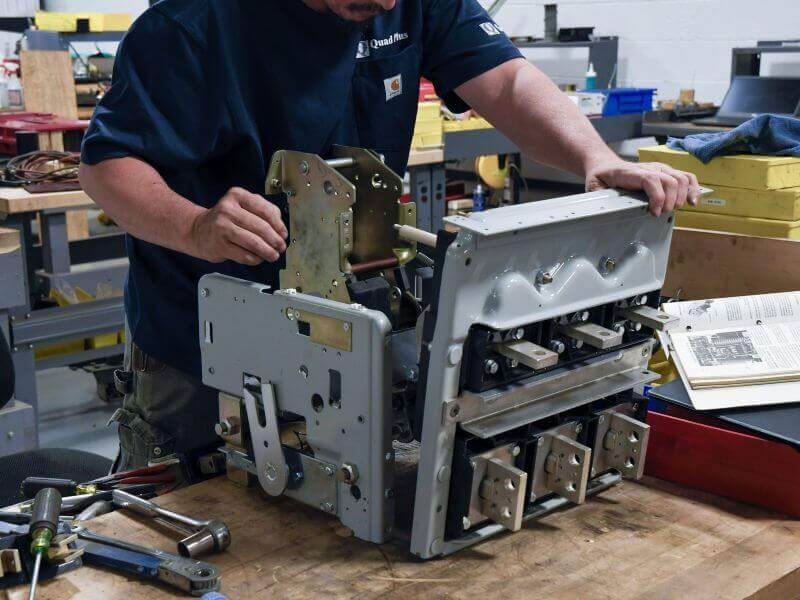
Upon evaluation, Quad Plus offers repair, refurbishment, and reconditioning in our dedicated circuit breaker repair and reconditioning facility in the Chicagoland area.


Importance of Circuit Breaker Testing for Industrial Operations
Properly functioning equipment is the best way to avoid costly downtime. Regular inspection and maintenance of circuit breakers will provide reliable operation and a longer working life.
Unlike a simple press of the circuit breaker test button or learning how to test a circuit breaker with a multimeter, professional testing evaluates every protective function. Basic checks can confirm the presence of voltage, but they cannot detect deeper issues, such as calibration failures, insulation breakdown, or sluggish mechanical response.
Professional circuit breaker testing ensures compliance and provides assurance that every breaker will protect your system exactly when needed.
Understanding Low- and Medium-Voltage Circuit Breaker Testing
Our circuit breaker testing procedures are aligned with NETA standards to ensure consistent, verifiable results. Each inspection step and electrical test is designed to validate the breaker’s performance against manufacturer specifications and industry requirements. The goal is to reduce the risk of unexpected failures in service.
- Main Component Inspections. All moving and stationary contacts, bolted electrical connections, and arc-chutes. This inspection is performed to verify the physical and mechanical condition of the equipment.
- Cleaning Key Components. Dusting, wiping, brushing, and greasing.
- Resistance Measurements. Confirms proper electrical continuity across each contact point, often using micro-ohmmeter methods.
- Megger Testing. Used to test the insulation of the breaker and safeguard against shorting throughout the mechanism.
- Primary Injection Test. Verifies that the breaker will trip during a fault and provide overload protection during the fault.
- Mechanical Operation and Contact Alignment Tests. Ensure the mechanical aspects of the breaker are functioning properly.
- Circuit Breaker Lubrication. Ensures the proper operation of moving, current-carrying parts and sliding surfaces.
- Detailed Reporting. Summarizes the as-found condition of each circuit breaker and our professional recommendations for remediation if necessary.

Essential Circuit Breaker Testing Types and Their Importance
The Benefits of Expert Circuit Breaker Testing Services
Circuit breaker testing goes beyond simple pass/fail checks, and a built-in circuit breaker test button provides only a basic check. A full evaluation requires a calibrated circuit breaker tester, which provides deeper insight into the breaker’s health and verifies its performance under fault conditions.
All testing is performed to NETA ATS standards and supports compliance with NFPA 70B and NEC requirements.
Together, these tests provide a comprehensive picture of the breaker’s condition, allowing you to address minor issues before they escalate into major failures.
Common Problems We Uncover During Circuit Breaker Testing
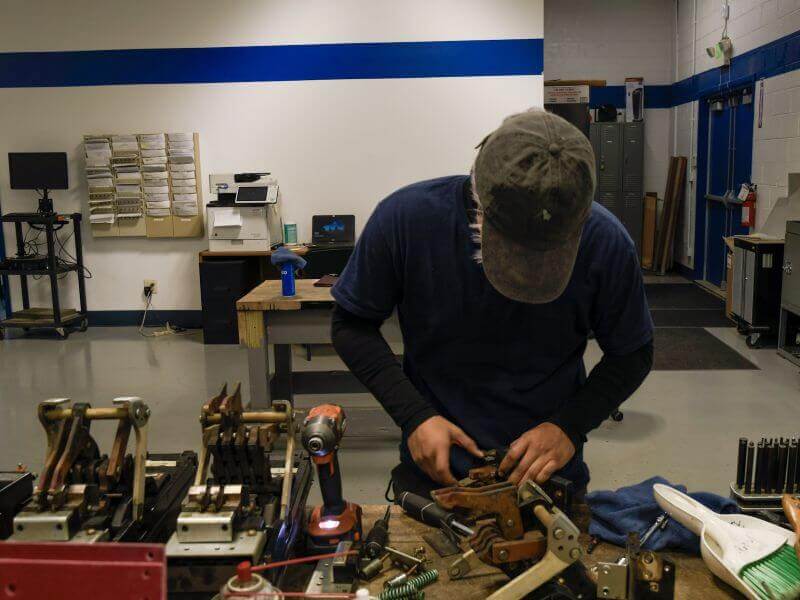
During testing, our technicians frequently find issues that would otherwise go unnoticed until a failure occurs. Breakers may have weakened insulation that no longer provides full protection, or contacts that are eroded and causing excess resistance.
Mechanical wear often shows up in sluggish operation or failure to latch properly, which can prevent a breaker from responding as designed. We also see signs of overheating at connections, indicating loose or degraded joints that can quickly escalate into a serious fault.
In some cases, trip units fail calibration and no longer respond within the required tolerances. Identifying and correcting these problems before they lead to outages is the core value of professional circuit breaker testing.
When these circuit breaker issues are detected, Quad Plus provides immediate recommendations and, if necessary, in-house repair or refurbishment services to restore reliability.
Prevent Failures with Professional Circuit Breaker Testing
Regular circuit breaker testing is crucial for preventing unexpected failures and ensuring the safety of your electrical systems. At Quad Plus, we provide comprehensive testing services to identify potential issues before they become costly problems. Contact us today to schedule a professional assessment.

Frequently Asked Questions
A circuit breaker is tested using a calibrated circuit breaker tester and injection equipment that simulates fault or overload conditions while measuring trip times and settings. Quad Plus performs primary and secondary injection testing, insulation resistance testing, and functional checks to verify proper operation under real-world conditions. While you can learn how to test a circuit breaker with a multimeter to confirm voltage presence, this method does not measure trip performance or overall reliability.
A breaker may be bad if it fails to trip during testing, shows signs of overheating, has irregular resistance readings, or physically won’t reset. At Quad Plus, we confirm breaker condition through controlled electrical testing, rather than relying solely on visual signals.
Replacement is necessary when a breaker fails compliance testing, shows excessive wear, or cannot be restored through repair, reconditioning, or refurbishment. If a breaker is obsolete and no longer supported, Quad Plus can recommend a retrofit or supply a refurbished replacement.