Power System Analysis and Studies

Load • Power Quality • Arc-Flash • Short Circuit / Coordination Studies

lower peak electricity costs with demand charge limiter software

Who we help: Plant Managers, Maintenance, Safety, Engineering, and Facilities

Quad Plus provides power studies that support safe operations, reliable performance, meet compliance requirements, compacity planning, and improve troubleshooting and planning for outages.

All studies are performed by professional engineers and developed in accordance with applicable IEEE, NFPA, ANSI, NETA, and PE.

lower peak electricity costs with demand charge limiter software

Why Quad Plus?

Power studies often determine whether a project moves forward or stalls. Quad Plus supports clients during equipment installations, system changes, and utility coordination by delivering clear, defensible engineering analysis that utilities and authorities can act on.

We speak utility language, so you do not have to. We collect the right data, build accurate system models, and communicate results in utility ready formats. This reduces review cycles, limits rework, and supports faster approvals.

Quad Plus combines professional engineering with systems integration, commissioning, and industrial safety. Power studies are developed as part of the Integrated System Lifecycle and are designed to support both immediate decisions and long term operation.

What You Can Expect From a Quad Plus Power Study

Most Quad Plus power studies include the following deliverables, based on project scope and study type.

  • Site data collection: Electrical drawings, equipment information, utility data, and field verification as required.

  • System modeling and calculations: Electrical system models and study calculations appropriate to the application.

  • Engineering recommendations: Actionable findings focused on safety, compliance, performance, and future expansion.
  • Written engineering report: Clear documentation suitable for utilities, AHJs, and internal stakeholders.

  • Review meeting: A structured review of results, risks, and recommended next steps.
  • Implementation support: Optional engineering, integration, and commissioning support to carry recommendations into execution.

Arc Flash Risk Assessment

Quad Plus provides arc flash risk assessments to improve electrical safety and reduce operational risk. Our approach focuses on accurate system modeling, defensible calculations, and clear documentation that supports safer work practices and compliance.

Our engineers calculate incident energy levels and arc flash boundaries for each applicable location in the power system. Results are used to define safe working distances, appropriate PPE, and mitigation options when risk levels are too high.

All studies are performed in accordance with applicable standards, including NFPA 70E, NEC, OSHA, IEEE, and NESC.

Arc Flash Process

  • 1

    Walkdown

  • 2

    System model

  • 3

    Calculations

  • 4

    Report

  • 5
    Review and labeling
engineer in arc flash suit conducting power system analysis

Arc Flash Study Deliverables

Based on project scope, arc flash studies typically include the following deliverables.

  • Study review meeting: Walkthrough of findings, risk areas, and recommended actions.

  • One line diagram updates: Updated drawings that reflect current system conditions and study assumptions.

  • Arc flash study report: Clear documentation of calculations, results, and recommendations.

  • PPE guidance: Incident energy levels, approach boundaries, and PPE recommendations.

  • Optional training: Safety training focused on arc flash hazards and safe work practices.

  • Arc flash labels: Custom labels for equipment, with optional installation support.

Power Quality Studies

Quad Plus provides power quality and system level studies to help facilities diagnose electrical issues, plan changes, and improve reliability. These studies are used to identify root causes, evaluate system capacity, and ensure electrical systems perform safely under both normal and abnormal conditions.

Our engineers support clients throughout the system integration lifecycle, from planning and analysis through implementation and commissioning. Studies are not delivered in isolation. They are used to support real operational decisions.

Power Quality Issues

Power quality issues often appear as equipment problems, nuisance faults, or unexplained utility charges. Power quality studies identify electrical disturbances and define corrective actions that protect equipment and reduce operational risk.

  • Flicker
    Voltage fluctuations affecting lighting, sensitive equipment, or process stability.

  • Overheating neutrals and transformers
    Excessive harmonic currents increasing losses and thermal stress.

  • VFD faults and early failures
    Harmonic distortion impacting drives and motors.

  • Utility bill penalties
    Poor power factor or harmonic levels resulting in added charges.

Power Quality Study Process

  • 1
    Data logging, with duration adjusted to capture operating conditions

  • 2
    Data and system analysis
  • 3
    Engineering report with findings and recommendations
  • 4
    Review meeting and corrective action planning
  • 5
    Optional implementation support

Power Quality Study Types

Harmonics and Flicker Analysis

A harmonics analysis determines whether harmonic currents and voltages exceed recommended limits as defined by IEEE 519 and whether remedial actions are necessary. The study typically includes on-site harmonic distortion measurements, data collection, power system modeling, engineering analysis, and a report with results and recommendations. Examples of these solutions include the installation of tuned harmonic filter banks, phase shifting, and zig-zag transformers.

Power Factor Correction Study

When it becomes necessary to increase system capacity, improve efficiency, or stabilize voltage profiles, a power factor correction study evaluates how well the electrical system supplies connected loads. The study analyzes real (kW) and reactive (kVAR) power flow across the system to define capacitor sizing and placement, estimate equipment payback, and assess potential utility penalties, including situations where penalties can be eliminated entirely, as demonstrated in our Power Factor Correction Case Study.

Load and Capacity Studies

Load and capacity studies evaluate whether an electrical system can support current operations and planned changes. These studies are commonly used during expansions, equipment additions, or when troubleshooting complex system behavior.

Reasons to Perform a Load Study

  • Capacity planning
    Determine available capacity for new equipment or process changes.
  • Simpler troubleshooting
    Understand system behavior and power flow under normal operation.

Load Study Types

Load flow studies

Evaluate voltage, current, and power flow throughout the system to confirm operating conditions remain within safe limits. Load flow studies are commonly used during system design, expansions, or equipment additions to identify capacity constraints and the need for additional equipment or services.

Transient Motor Starting Analysis

Evaluates the impact of motor inrush current on system voltage during startup. This analysis determines whether motors can start reliably without causing voltage drops that lead to stalling, nuisance trips, or premature equipment wear.

Protection and Fault Studies

Protection and fault studies evaluate how your electrical system responds when something goes wrong. These studies are used to ensure faults are cleared safely, damage is limited, and outages are contained to the smallest possible area.

Quad Plus combines short circuit analysis and protective device coordination into a single, practical protection study. Different fault analyses are performed depending on whether the study supports coordination, arc flash, or both. The goal is not just compliance, but predictable system behavior under abnormal conditions.

When Protection Studies Are Needed

  • New equipment installations: Verify existing protection can safely handle added loads.
  • Changes to service size or distribution: Confirm fault duties and protection settings remain appropriate.
  • Utility system changes: Evaluate the impact of utility modifications on fault levels and protection response.

When Protection Studies Are Needed

  • Available fault current throughout the system
  • Equipment interrupting and withstand ratings
  • Protective device settings and selectivity
  • How faults are cleared and where interruptions occur

Services Available

Quad Plus offers a wide variety of services to assist you no matter where you are in the system integration lifecycle. For new builds, we offer design and project management services, for existing plants, we can make your operation run smoother and more efficient. For plants with obsolete control systems, we can assist with retrofits and upgrades. No matter your business need, we have you covered!

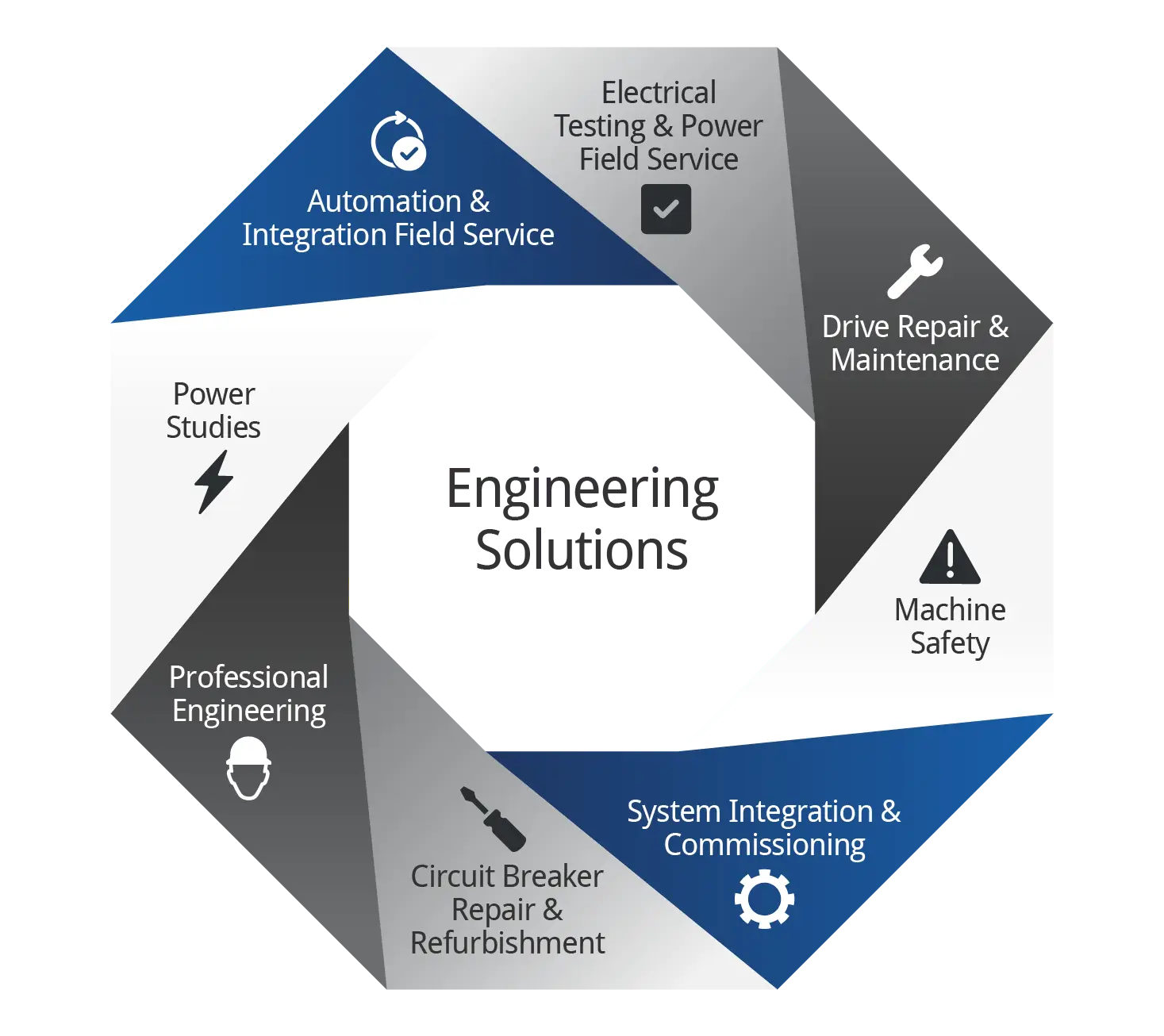
power system analysis engineering linear dark text sm
automation system integration life cycle

Let’s Get Connected

We specialize in low and medium voltage power systems and our crew has the experience to precisely target and correct power issues to streamline your production and move stalled projects to completion. Quad Plus is your all-inclusive power systems solution provider for all power services needs.

What you can expect when working with Quad Plus:

  • Fast response when power issues or project timelines are critical
  • Professional engineering led studies grounded in industry standards and real world application
  • Implementation support to help carry findings into execution, not just reports

Ready to start the conversation?
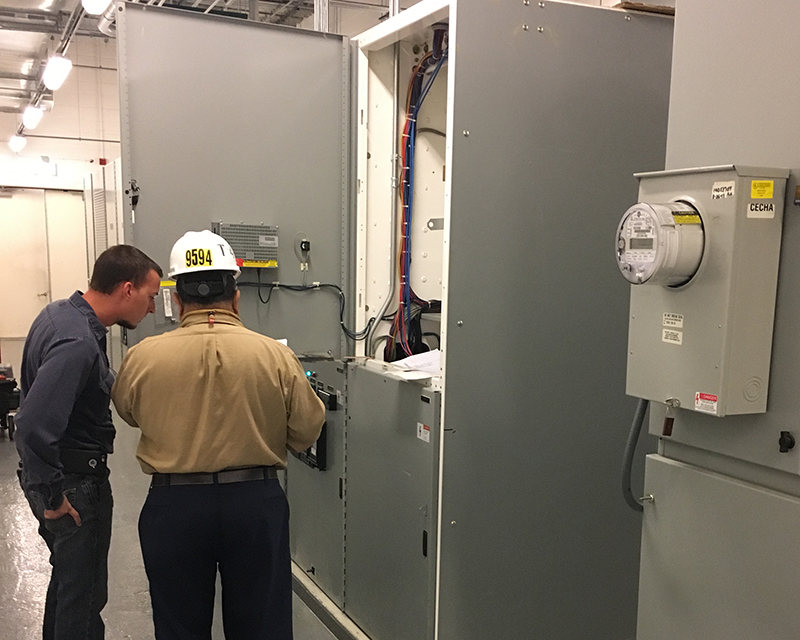
power studies performed by electrical engineers