Case Study:
Detecting and Repairing a Failing Circuit Breaker Safely
Continual Faults Cause Significant Loss for this Food & Beverage Customer
Objective
- Diagnose continual outages in food and beverage plant.
Solutions
- Planned a 3-day outage with rolling blackouts to minimize disruptions and maximize equipment service.
- Immediately addressed issues such as failing circuit breakers that pose an immediate threat to personnel and equipment.
- Documented remaining problems so another planned outage can be conducted to resolve outstanding issues.
Results and Benefits
- Restored a safe working environment for plant personnel.
- Improved safety for equipment to avoid costly breakdowns.
- Virtually eliminated unexpected downtime due to faulty breakers and saved the customer overtime and equipment replacement costs.
- Helped the customer to understand the benefits of circuit breaker preventive maintenance.

Background
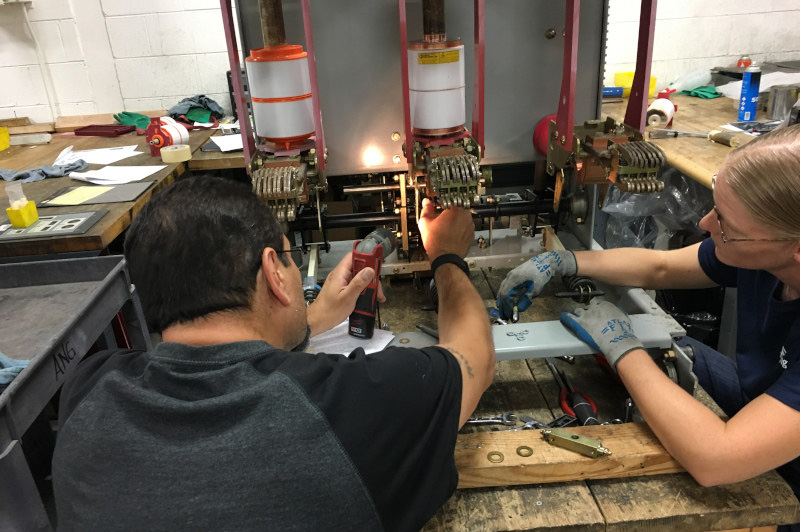
The Quad Plus team was called out to this customer in the food and beverage industry to get to the bottom of their continual faults and outages. Because the customer runs a continuous process, if one part of the process goes down, it results in exponential losses. The outages impacted their production schedule and cost tens of thousands of dollars in gear replacement and overtime labor for maintenance personnel and contractors.
The main problems for the industrial circuit breaker testing team included:
- Insulated case circuit breakers with faulty trip units that would not open during an actual fault.
- Breakers with mechanical damage from rough handling or age
- Breakers in need of lubrication were no longer operating as expected.
- The low-voltage distribution breakers spanned a number of makes and models, such as Siemens WL, GE AKRU, ABB SACE, and ITE K-Line.
Quad Plus Solution
We planned for a three-day outage of rolling blackouts in the plant. The objective was to resolve the issues that posed an immediate danger to plant personnel and equipment, along with those that would bring production to a halt. By staggering the outage, we could work around other trades and crafts to maximize the amount of equipment serviced while minimizing the impact on other work.
We then documented the remaining issues so proper action could be taken during the next scheduled outage. The customer now understands that intentionally taking a plant down for several days is costly and inconvenient. However, doing so allows for the outage to be planned and has an expected completion time, making it far more efficient than an unexpected shutdown.
Need Expert Support for Aging Circuit Breakers?
If you’re seeing signs of failure or managing aging insulated case circuit breakers, Quad Plus can help! We’ll inspect your breakers, help you evaluate your circuit breaker repair vs. replacement options, and restore your system reliability.
Understanding Insulated Case Circuit Breakers
Insulated-case circuit breakers (ICCBs) are designed to provide circuit protection with higher interrupting capacities than molded-case breakers. Their modular construction and adjustable trip settings make them suitable for complex systems.
ICCBs feature a two-step mechanism: a primary contact for current conduction and an arc chute to safely extinguish electrical arcs during fault conditions. They are commonly used in medium-voltage applications where space, reliability, and performance are critical.
Signs and Symptoms of a Failing Circuit Breaker
Early signs of insulated case circuit breaker failure can be subtle, but the effects can escalate quickly. Regular maintenance and inspections will help spot visible wear and other problems to help prevent unplanned outages. Some signs of a failing circuit breaker include:
-
Inconsistent Tripping:
The breaker trips under normal loads or fails to trip during a fault.
-
Visible Damage:
Burn marks, cracks, or warped components indicate overheating or internal failure.
-
Unusual Sounds:
Buzzing, clicking, or grinding noises during operation suggest mechanical issues.
-
Heat Buildup:
Elevated temperatures at terminals or casings can mean poor connections or internal faults.
-
Difficulty Resetting:
The breaker doesn’t reset properly or requires excessive force to operate.
Common Causes of Failing Insulated Case Circuit Breakers
ICCB failures are often the result of wear, contamination, or lack of maintenance. Over time, mechanical and electrical components can degrade and increase the risk of failure and nuisance trips. Here are some common causes of failure for insulated case circuit breakers:
-
Mechanical Wear.
Frequent operation can degrade linkages, latches, and springs.
-
Contact Erosion.
Arcing during fault interruption erodes contacts and reduces effectiveness.
-
Environmental Contamination.
Dust, moisture, and corrosive particles can compromise insulation and moving parts.
-
Aging Insulation.
Heat and electrical stress can weaken insulating materials and lead to breakdowns.
-
Improper Maintenance.
Missed inspections or incorrect adjustments can leave issues undetected and unresolved.
Preventive Maintenance Strategies for Insulated Case Circuit Breakers
Regular visual inspections, mechanical operation tests, insulation resistance testing, and contact resistance measurements should also be performed.
Preventive maintenance for ICCBs, including cleaning, lubricating moving parts, and recalibration of trip units, should be performed according to manufacturer guidelines.
Scheduled maintenance intervals should be based on breaker duty cycles, environmental conditions, and the criticality of the application to ensure continued reliability and extend service life.
Protect Your Operations with Reliable Circuit Breaker Solutions
Experiencing issues with failing insulated case circuit breakers? Quad Plus offers expert diagnosis and repair services to restore functionality and ensure the safety of your electrical systems. Our skilled technicians work efficiently to minimize disruptions and keep your operations protected.
Contact us today to learn how we can help maintain the reliability of your circuit breakers and enhance the safety of your facility.

Frequently Asked Questions
Maintenance should be performed every 1 to 3 years, depending on operating conditions and load cycles. Breakers in harsh environments or critical systems may require more frequent inspection and testing.
Many circuit breakers can be repaired if the failure is limited to mechanical wear or component degradation. However, if core elements like the frame, insulation, or contact assemblies are compromised, a full replacement may be necessary and more cost-effective.
Insulated case circuit breakers (ICCBs) combine features of molded case and air circuit breakers. They offer higher interrupting capacity, adjustable trip settings, and modular construction for flexible protection in commercial and industrial power systems.